MetaTune in a nutshell
Reconfigurability using inversely designed metasurfaces
Why reconfigurable metasurfaces matter?
Electromagnetic waves, characterized by their wavelength, encompass a spectrum ranging from radio waves (longest wavelength) to gamma rays (shortest). These waves propagate through space as oscillating electric and magnetic fields and have unique properties, such as high speed and the capability to interact with charged particles, that underpin numerous applications in communication, medicine, energy production, and beyond.
Consequently, controlling EM waves is a focus of major and emerging corporations.
But what do reconfigurable metasurfaces have to offer in this field?
Reconfigurable metasurfaces are planar artificial media composed of sub-wavelength structures, termed meta-atoms.
By incorporating active elements, reconfigurable metasurfaces introduce a novel degree of freedom, facilitating dynamic manipulation of electromagnetic (EM) waves. Offering compact, lightweight, and energy-efficient solutions, reconfigurable metasurfaces constitute a versatile enabling technology with applications spanning the entire electromagnetic spectrum.
This technology holds significant potential to address a wide range of challenges. For example, their capability to spatially distribute phase delays between neighbouring meta-atoms opens the possibility for controlling the direction of propagation of reflected and transmitted waves, and by introducing dynamic control of this spatial phase distribution, one can perform beam steering at different frequencies.
Beam steering is crucial for developing a new generation of point-to-point communication systems that allow controlling and tailoring propagation channels at THz frequencies, introducing the commonly called “reconfigurable intelligent surfaces” (RISs) for 6G. At the same time, performing efficient beam steering at infrared frequencies is the base of a sensing system based on light detection and ranging (LiDAR) with direct applications to autonomous vehicles, remote sensing, and displays in augmented/virtual reality (AR/VR) modules.
At optical frequencies, reconfigurable metasurfaces can play an essential role in advanced imaging, controlling wavefronts with compact broadband lenses or spaceplates that can tune the focal point, reconfigurable holograms, and controllable polarizers opens the possibility of disruptive imaging systems.
Finally, reconfigurable metasurfaces can play an important role in thermal management. Thermal metamaterials are artificial materials used to manipulate thermal radiation. Their potential applications include thermal lenses and selective controllers of infrared emissivity that can be used for heat image camouflage, radiative heat transfer control, thermal diffusion, etc.
Reconfigurable metasurfaces are one of the game-changing technologies that will redefine the industry in portable electronic devices, smart environments, and the next-generation communication systems.
However, to transform this technology from laboratory to commercial devices, critical technological gaps need to be filled to convert the prospective applications into reality.
Current technological limitations
Number of operational states:
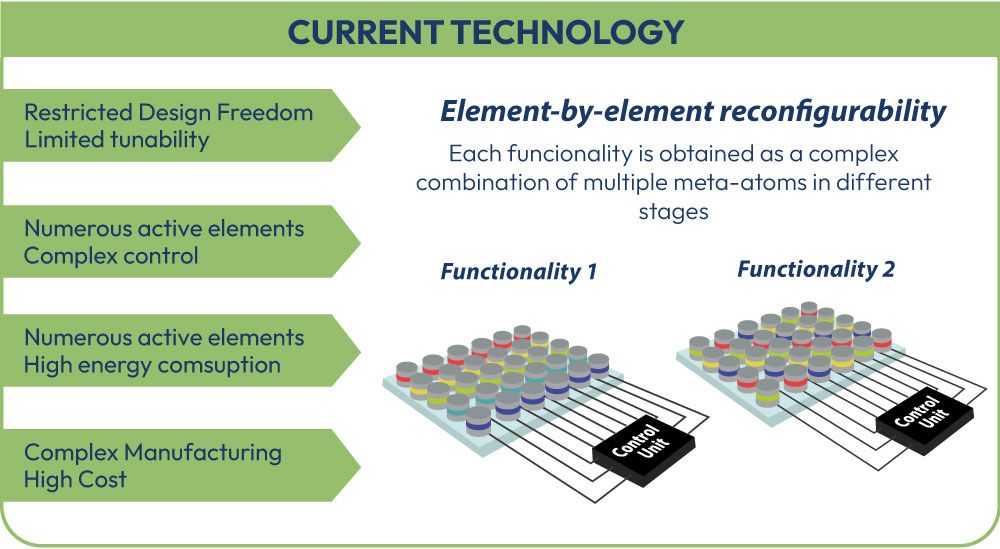
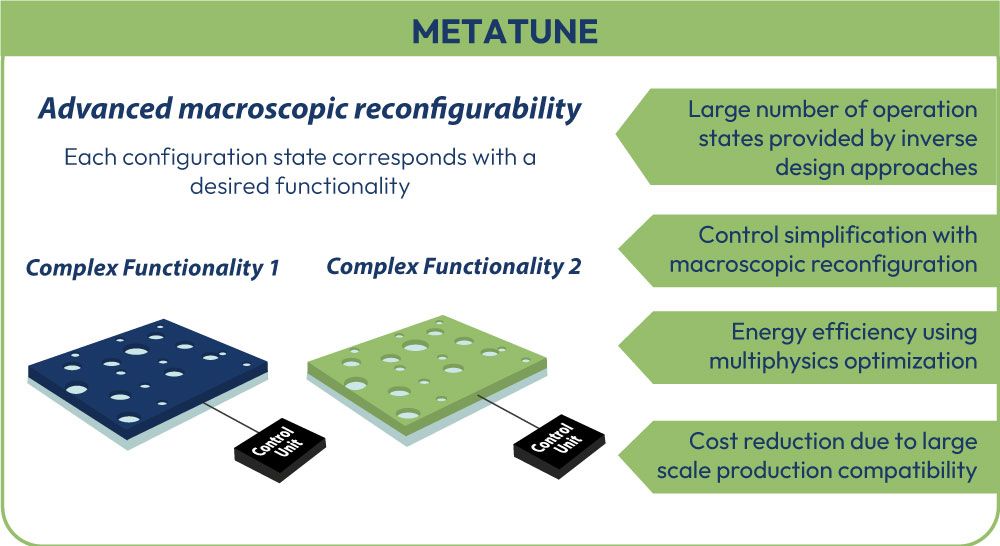
Electrically reconfigurable metasurfaces whose operational state is changed when applying an external voltage are interesting due to the simplification in the integration with other electronic devices. Many of the target applications rely on continuous tuning schemes, forcing the implementation of multiple tuning states where the metasurface gradually changes the response. As a result, traditional analytical or semi-analytical solutions based on element-by-element tunability become useless and, as the number of operational states increases and represent a significant challenge for realistic and affordable implementations due to the extremely small device features required and the energy consumed in switching thousands of elements. For these reasons, the design tool should optimise not only the electromagnetic response but also introduce user-defined goals that can incorporate constraints related to the chosen fabrication techniques, materials selection, size, weight, and power considerations.
Mass production:
The widespread adoption of reconfigurable metasurfaces lies in developing scalable manufacturing and packaging processes. Unlike their passive counterparts, fabricating reconfigurable metasurfaces requires not only large-area high-precision patterning, but also the integration of reconfigurable elements that allow the tunability of the metasurface response. Therefore, manufacturing practices for reconfigurable metasurfaces must manage the escalating complexity of devices by integrating reconfigurable materials and new functions and, at the same time, leveraging from standard fabrication processing and packaging.
Endurance:
Endurance requires the characterization of degradation, thorough material investigations to elucidate the pertinent failure mechanisms, and optimizations of the designs to improve the robustness and resistance to fatigue. The endurance of reconfigurable metasurfaces must be verified beyond laboratory conditions, as an essential step to ensure that reconfigurable metasurfaces make a lasting impact across the potential applications.
MetaTune Applications
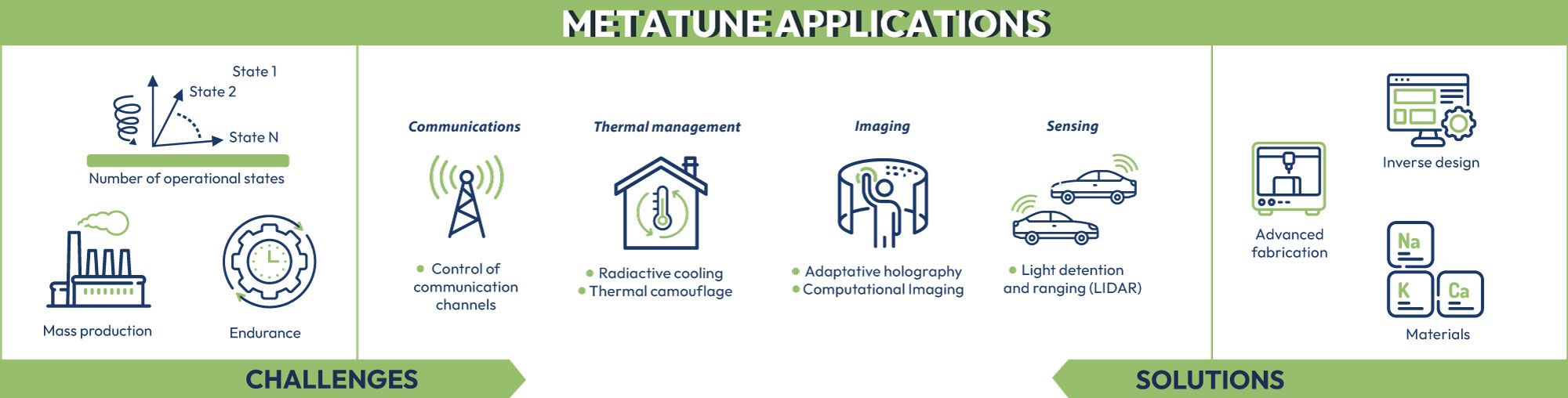
Addressing the current challenges requires integrating design, manufacturing, and materials research, which can be achieved only by developing novel design strategies that work in symbiosis with the constraints imposed by the materials and fabrication techniques.
A key goal of MetaTune is to prepare and train future scientists and engineers for the challenges and opportunities provided by a new class of reconfigurable metasurfaces that combine simplicity of implementation, large number of operational states, long-life cycles, and low power consumption.
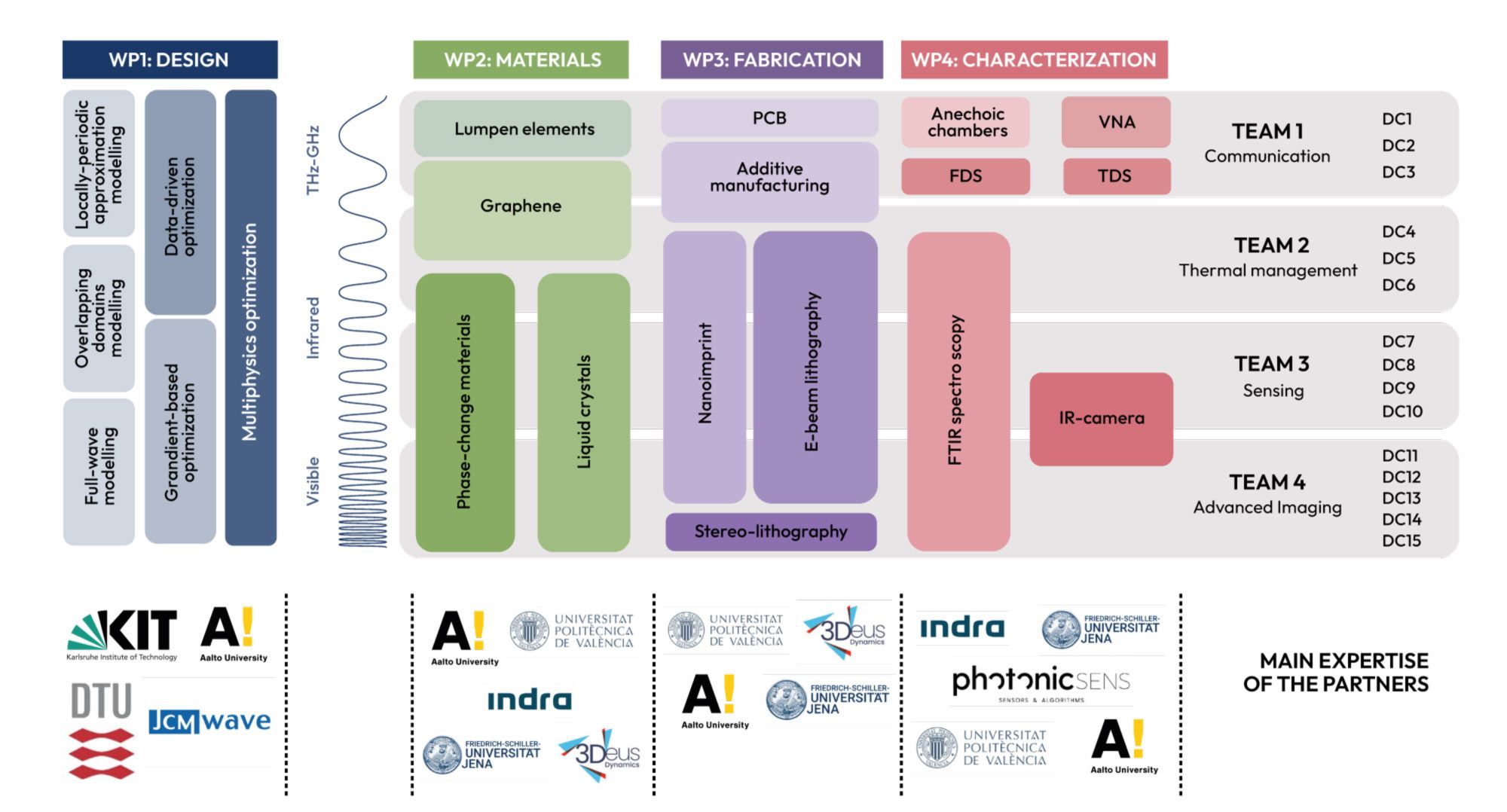
To this end, the 15 doctoral candidates (DCs) will work on developing design techniques for controlling the response of reconfigurable metasurfaces, exploring and analysing reconfigurable materials, and developing fabrication approaches for simple and cost-effective production.
The development of these three areas is necessary to meet the technical requirements of the industry and progress toward the integration of reconfigurable metasurfaces in existing industrial systems. Following multidisciplinary training, MetaTune will ensure that all DCs have the required knowledge to develop the next generation of reconfigurable metasurfaces with a holistic approach.
The Consortium comprises 9 leading partners: five academic and four industrials. On the one hand, Universitat Politècnica de València (UPV), Aalto University (AALTO), Danmarks Tekniske Universitet (DTU), Friedrich-Schiller-Universität Jena (JENA), and Karlsruher Institut für Technologie (KIT) provide academic support for the doctoral scheme. On the other hand, PhotonicSens (PSENS), JCMWAVE GmbH (JCM), 3DEUS Dynamics SAS (3DEUS), and Indra (INDRA) endorse the industrial vision and ensure alignment of the objectives defined in MetaTune with the industrial needs. Within this consortium, the DCs will acquire theoretical, experimental, technical, and transversal skills to enhance their career opportunities in industry and academia.
Research Objetives
The main goal of this proposal is to leverage innovative design methodologies that combine accurate modelling with powerful optimizations, advanced materials and facilities to achieve reconfigurability in high-impact applications, including communications, imaging, thermal management, and sensing.

OBJ1
Development of reconfigurable intelligent surfaces working beyond 100 GHz. Team 1
(DC1, DC2, DC3)

OBJ2
Development of metasurfaces for controlling thermal emission. Team 2
(DC4, DC5, DC6).

OBJ3
Development of photonic metasurfaces for sensing.
Team 3
(DC7, DC8, DC9, DC10).

OBJ4
Development of photonic metasurfaces for imaging.
Team 4
(DC11, DC12, DC13, DC14, DC15).